
Why you'd want this
You already know these feelings.
Each one is a specific, ordinary part of a job search that software should have fixed by now. Here's the pain, and here's what fixes it.
You hate that resume tailoring is a slot machine.
A score that never guesses.
Most checkers ask an LLM. One popular tool scored the same resume anywhere from 66 to 99 across a hundred runs. Maestro has no LLM in the scoring path at all, so the same resume against the same posting returns the same number and the same breakdown. Every time.
Your folder is a graveyard of resume_v2_FINAL(3).docx.
Version history, not a pile of copies.
Every edit becomes a version: manual, chat, tailoring run, even a restore. Diff any two. Restore any one. Old variants get archived instead of deleted, so the bullet you wrote in March is still findable in September.
You're not sure your resume is even good enough to send.
A grade, and what each flaw costs you.
The Health Report checks one resume on its own merits: parsing, dates, evidence quality, format gates. You get a letter grade and a fix list ranked by impact. Fail a fatal gate and tailoring is blocked, because reordering a broken document doesn't repair it.
LaTeX looks great and is miserable to edit. Tailoring one, unthinkable.
LaTeX quality without LaTeX editing.
You edit content in a structured editor. A bullet is a bullet, not a .tex line you hand-patch. Layout stays the template's job, so changing a word can't break your formatting.
How many resume templates have you changed in your life?
One or two. Here it's a button.
In Word or raw .tex, a redesign means rebuilding the document, so nobody bothers. Here a template owns presentation and nothing else. The same content renders through any design without being touched.
You're answering the same screening questions for the fourth time.
Answer once. Reuse forever.
Cover letters and screening answers come from your Career KB and the answers you've already given. The extension fills forms from your Autofill Profile. Credentials, signatures, consent boxes and government IDs are deny-listed and stay yours to type.
You do the work. You never find time to write it down.
Drop the raw material in. Get structure back.
Every resume variant you own, plus project write-ups, certifications, review notes. Maestro resolves duplicate entities across them, clusters the bullets and synthesises one Career Knowledge Base. That becomes the evidence base for everything downstream.
You don't actually know what the market wants for your roles.
Your own postings, quantified.
Every job you capture feeds a picture of the market you're really applying into: top skills, a skill heatmap, role mix over time. Gaps sort into missing, already in your KB, or already on a resume. Frequent and missing is what to learn next. Frequent but already yours is what you keep forgetting to say.
You re-explain how you want to sound in every single prompt.
Say it once. It sticks.
Your persona holds who you are as a candidate: strengths, goals, working style, how your writing should read. Set it once and every generated document comes out in that voice. It shapes tone and emphasis, never facts.
You're tired of searching for jobs at all.
Send the assistant you already use.
Maestro hands your agent a brief: your preferences, your work-authorization answers word for word, the guardrails you set. Claude or Codex reads the boards, captures what fits, scores it against your bases and comes back with a ranked shortlist. No integrations to break.
You wish the form-filler knew everything your resume knows.
It does, per application.
The side panel fills from your Autofill Profile and grounds each answer in the application on screen, not a generic saved blob. Its telemetry logs which fields it met and whether they filled. It can't log what you typed, because the table has no column for it.
How it works
Evidence → base resume → application → typeset PDF.
That whole cycle is the part other tools cannot reproduce. Here is each step of it, with what the app actually shows you.
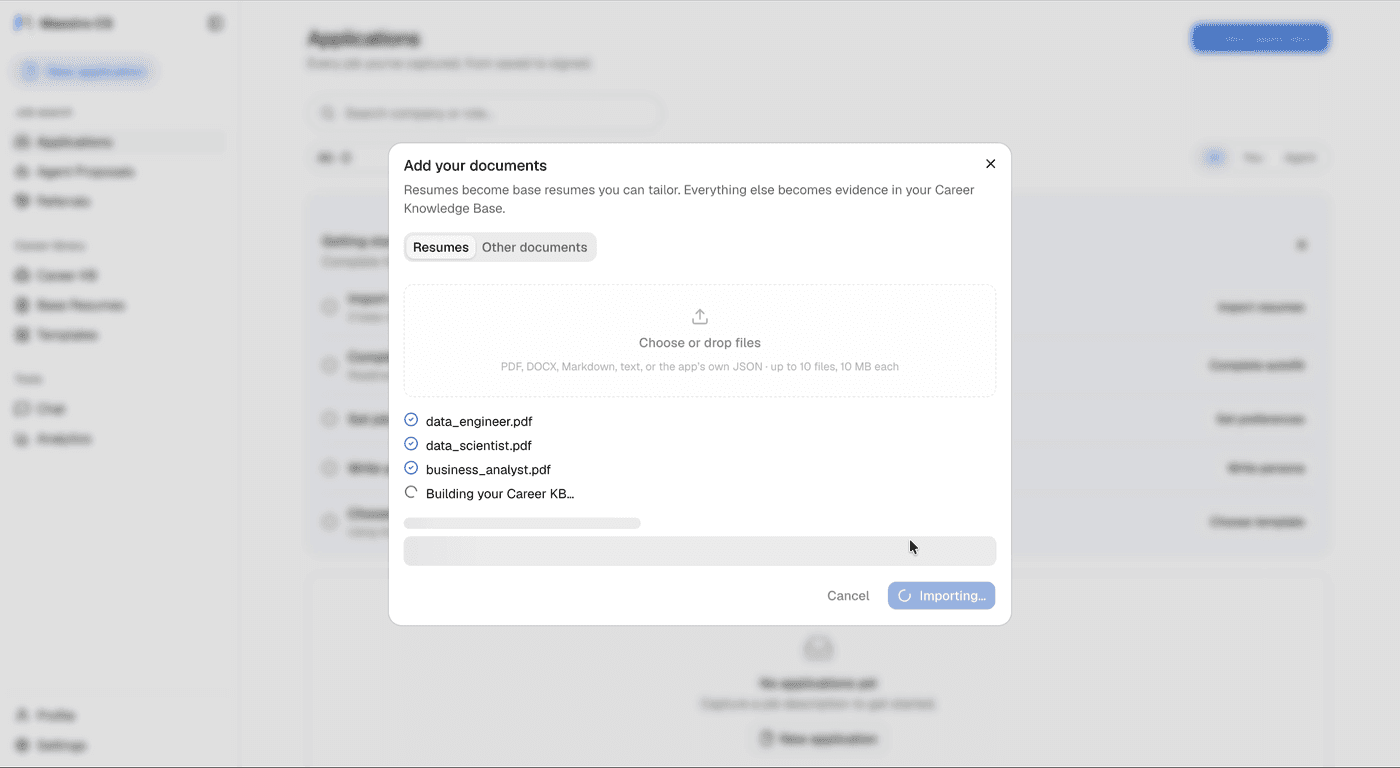
Feed the Career KB, once
Every resume variant you own. The old ones, the role-specific ones, the one that runs to three pages.
Maestro resolves duplicate entities across them, clusters the bullets and builds one Career Knowledge Base. This is the step that keeps paying: everything downstream composes from it, so its quality is the ceiling on everything else.
Build a base resume per track
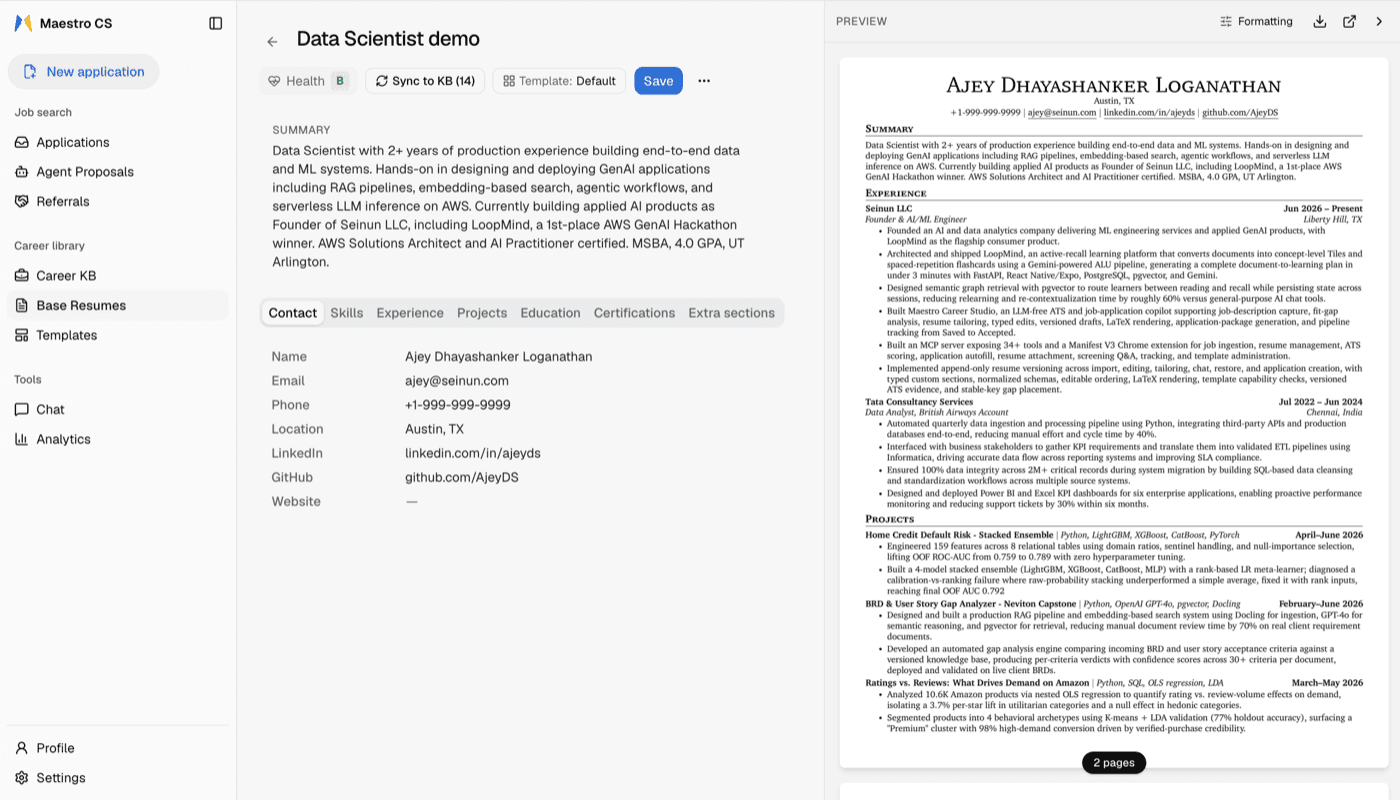
One per track you actually target. Not one per job.
“New base resume → From Career KB” proposes what belongs and tells you why it left the rest out, with a drafted summary. The instruction box steers shape, not facts: “lead with pipeline and cloud work, keep it mid-level, drop the teaching.”
Capture the job, then pre-scan it
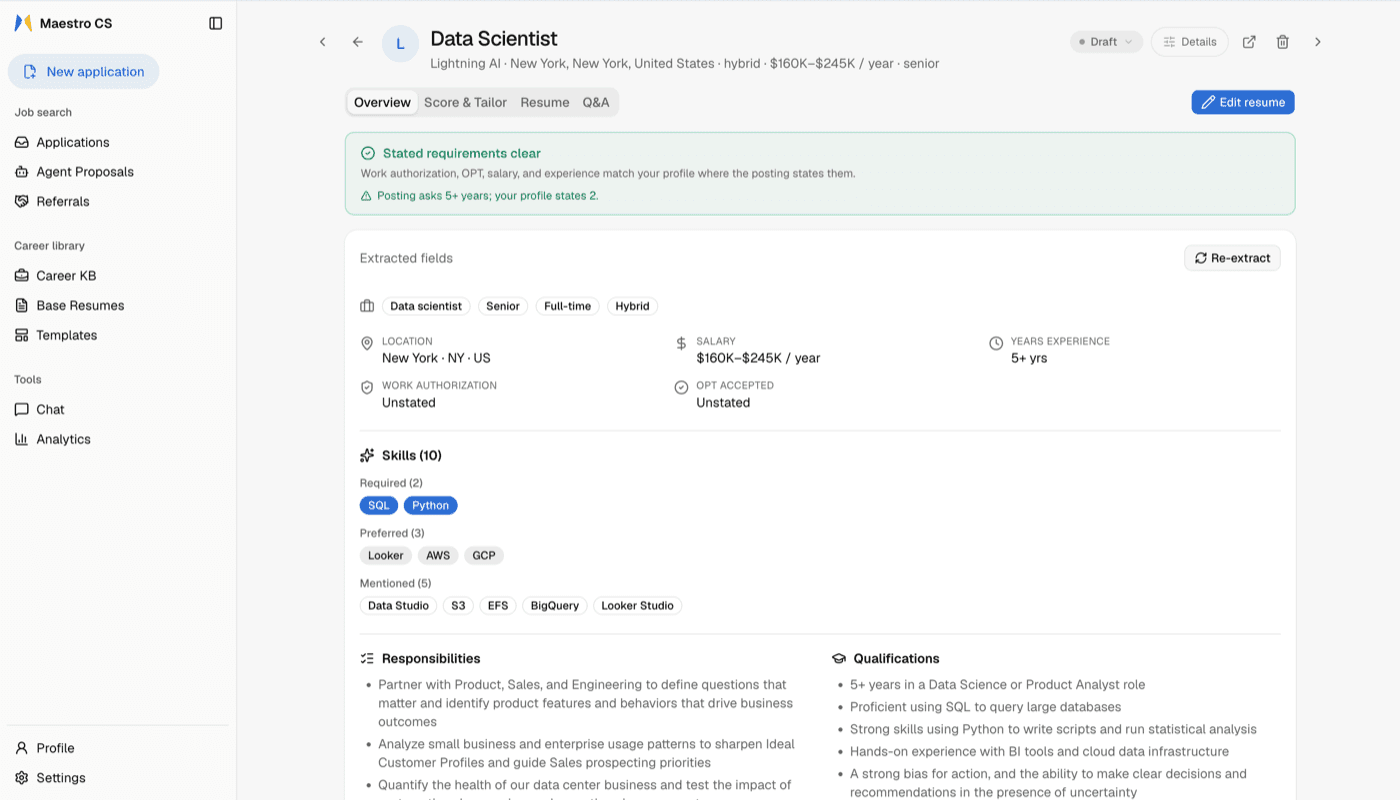
Paste the posting, or grab it with the extension from the board you're already reading.
Score it against every base. Then the knock-out pre-scan checks your profile against what the posting actually states: work authorization, OPT policy, salary, years of experience.
Work the gaps
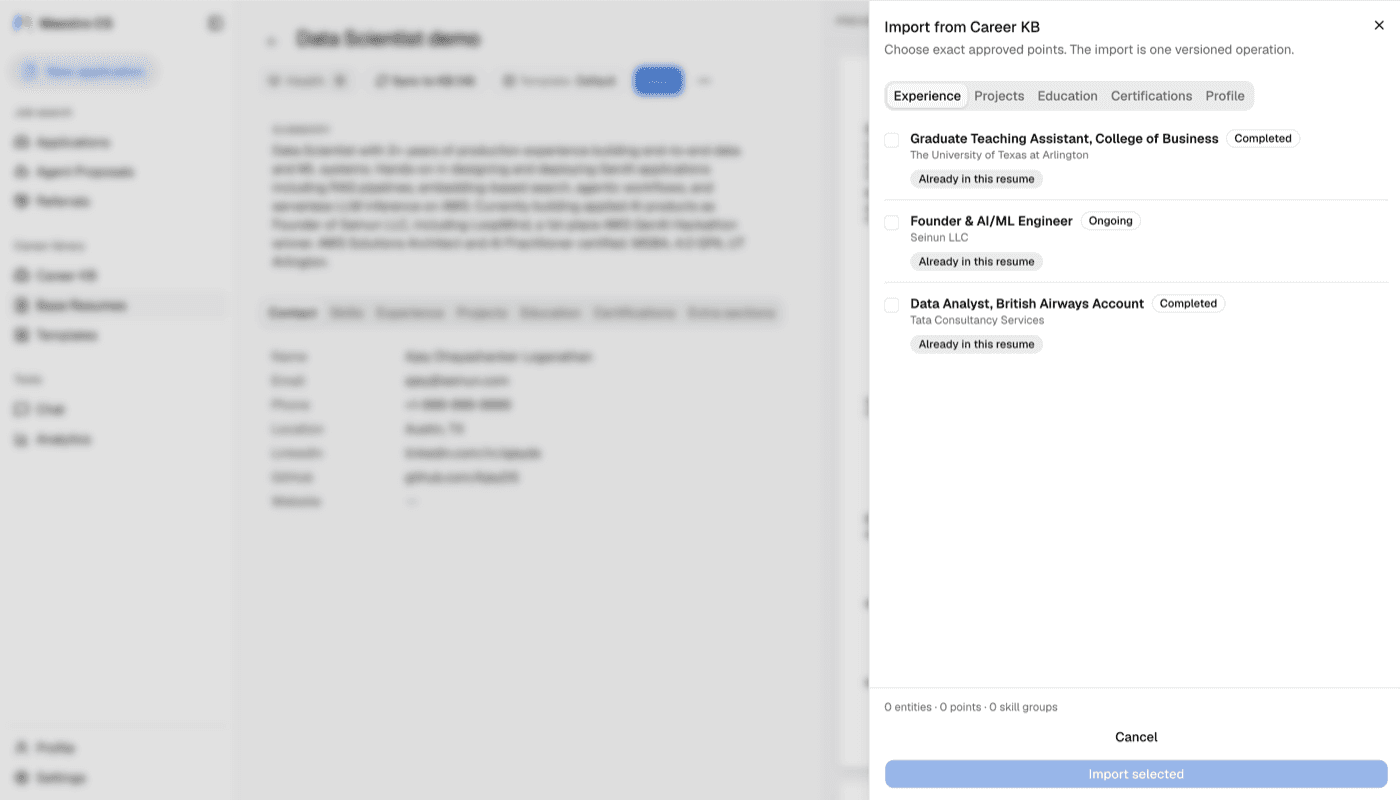
A gap is a requirement your resume doesn't evidence yet.
The workflow asks pointed questions to surface things that are true but unwritten. Close one and you've either produced new evidence that's yours permanently, or it stays a gap. That's the difference between tailoring and drifting.
Render it, read it, track it
Cover letter, screening answers, and a real LaTeX or Typst PDF compiled on your machine.
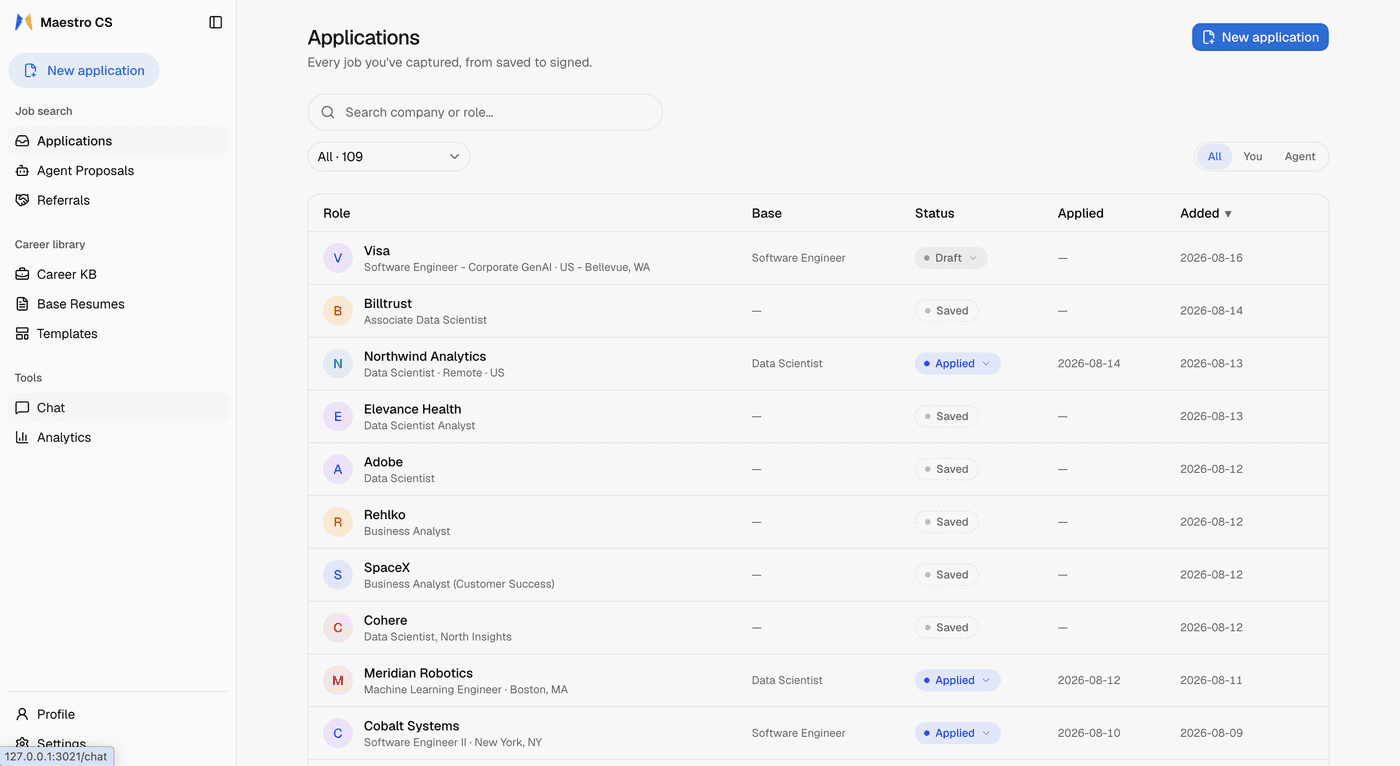
Read the output before it goes anywhere. Your name is on it. Then the tracker carries the application from Saved to Accepted, with inline status, filters for what you did versus what an agent did, and every render filed on disk.
The rule underneath all five
A gap is closed by evidence, or it stays a gap.
This is the whole discipline. Ask a general-purpose assistant for a tailored resume and you get fluent text that no longer quite matches what you did, in a layout it reinvents each time, with nothing kept between conversations.
Approved evidence composes verbatim
Nothing is invented at create time. Rewriting a bullet is a separate, explicit step that asks you first.
An unevidenced keyword can only reach your skills list
It can never become an experience bullet. That constraint survives Quick Tailor and the agent lane alike.
Every edit is a diff you can revert
Per hunk, on the record, with a resume version behind it. Nothing the AI does to your document is one-way.
And if you walk away, you keep everything.
Your Career KB exports to one career.md. Plain Markdown, no model involved, readable and diffable. Resumes are JSON on your disk. Every render sits in its own company-and-role folder with the source and the exact PDF you sent.
The record is yours. That is the whole design.
Career tooling should be infrastructure, not a rental.
Clone it, run it, keep everything it produces. Nothing here was built to make leaving hard.
Apache-2.0 · no account · no subscription · your data stays on your disk